Primary mode
Motorcycle = 78.3%
Using a discrete choice experiment for Hanoi residents, this study estimates how acceptance changes across policy bundles that combine restriction scope, travel cost changes, public transport improvements, fare relief, green reallocation, park-and-ride, transition support, and revenue governance. The analysis estimates mixed logit models, derives willingness-to-pay values, and identifies heterogeneity by dependency, income, trust, and environmental concern. Results show that a pull-first and support-first pathway is more acceptable than a push-first pathway.
Hanoi faces a policy dilemma. Air quality and congestion conditions justify intervention, but motorcycles remain central to household mobility and income generation. The implementation gap appears when restrictions move faster than alternatives.
This study tests the conditions under which residents accept a fossil-fuel motorcycle phase-out package. It quantifies trade-offs among push, pull, and support attributes, then estimates preference heterogeneity across socioeconomic and attitudinal profiles.
Primary mode
Motorcycle = 78.3%
Motorcycle ownership
At least one = 85.8%
Model baseline
ASC = +1.621
Model fit
ρ2 = 0.28
Core policy signal
Pull + support outperform push-first


This study uses a stated-preference discrete choice experiment (DCE) under random utility theory. Respondents in Hanoi completed repeated choice tasks. In each task, they chose between policy bundles and a status-quo option.
Each bundle was built from eight attributes with three levels each: restriction scope, travel-cost change, alternative transport quality, fare relief, transition support, green-space reallocation, park-and-ride, and revenue governance. The design generated 27 orthogonal profiles, split into 3 blocks; each respondent completed 9 tasks.
We estimated mixed logit models for main effects and interaction effects. Interaction terms tested heterogeneity by motorcycle dependency, income, trust, and environmental concern. Willingness-to-pay values were calculated as coefficient ratios to the cost term, WTPk = βk / (-βcost). The design target was n = 400 and the realized sample was n = 320.
The scenario simulation in Section 3A is directly linked to these estimated coefficients. It is not a market-share forecast. It is a transparent comparison tool that helps non-technical readers understand direction and relative magnitude across policy bundles.
DCE attributes
8 attributes, 3 levels each
Design profiles
27 orthogonal profiles
Blocking
3 survey blocks
Tasks per respondent
9 choice tasks + status quo
Sample
Target n = 400, realized n = 320
Uni = Vni + εni
Vni = β'Xni
WTPk = βk / (-βcost)
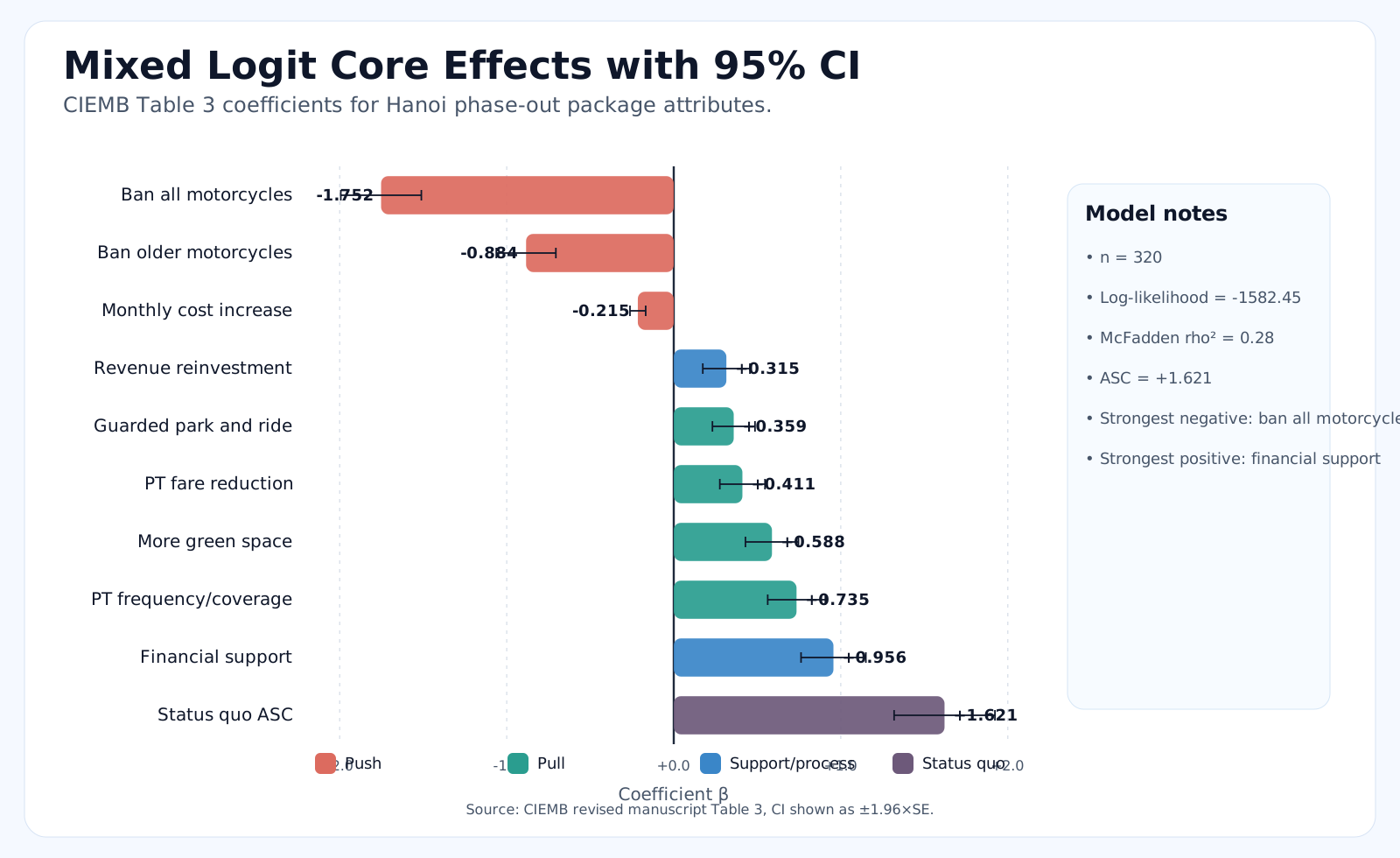
The model identifies a strong status quo pull, large disutility for broad restrictions, and strong positive utility for pull and support attributes. Heterogeneity is consistent with dependence, income, trust, and environmental concern channels.
Model fit
ρ2 = 0.28
Status-quo preference
ASC = +1.621
Strongest negative β
Ban all motorcycles = -1.752
Strongest positive β
Financial support = +0.956
Heterogeneity signal
σ significant on key random terms
Reported coefficients and 95% confidence intervals from Table 3, grouped as push, pull, support-process, and status-quo terms.
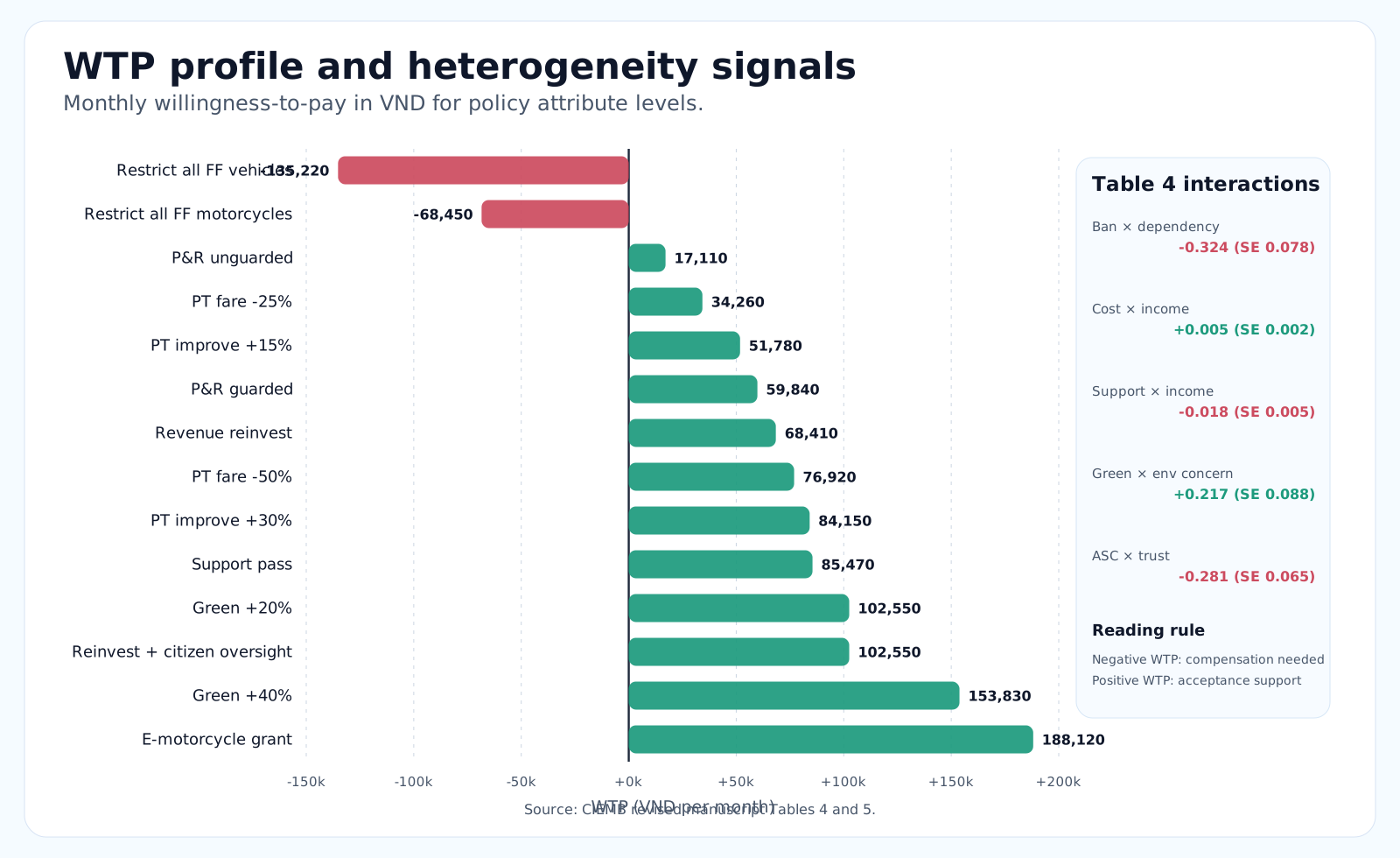
Reported WTP ordering from Table 5 with selected interaction terms from Table 4. Positive values support acceptance; negative values indicate compensation required.
Ban intensity produces the strongest negative effect, with substantial heterogeneity in the random term (σ for broad ban is large).
Motorcycle dependency strengthens opposition to broad bans (β = -0.324). Higher income reduces cost sensitivity (β = +0.005) and lowers grant valuation (β = -0.018).
Trust lowers status-quo pull through the ASC interaction (β = -0.281), supporting a governance-first communication strategy.
Environmental concern raises support for green-space reallocation (β = +0.217), indicating stronger acceptance of visible co-benefits.
This module converts estimated coefficients into scenario comparisons. It is a communication tool, not a demand forecast. In this index, push has a negative sign, while pull, support, and trust have positive signs.
Higher values represent stricter scope and higher burden from push-side policy terms.
Represents public transport frequency, fare relief, greenery, and park-and-ride quality.
Represents transition grants and revenue governance transparency.
Higher trust lowers status-quo attraction and improves acceptance feasibility.
Acceptance score
0/100
Rollout status
Pending
Alternative readiness
0%
Burden pressure
0%
Transition trust
0%
Readiness gap
0 pts
Compensation gap
0 pts
Trust buffer
0 pts
Utility shift
ΔU = 0.00
High-acceptance chance
0%
Primary lever
-
Pull
0%
Support
0%
Calibrate
0%
Restrict
0%
Adjust policy mix to reduce burden before scale-up.
The managerial implication is sequencing discipline. Restriction scale-up should follow measurable readiness, support reach, and trust conditions.


Prioritize frequent and reliable public transport, fare relief, and usable interchange capacity before tightening restriction scope. This aligns with positive pull coefficients and high WTP for quality improvements.
Protect dependence-heavy and lower-income groups with e-motorcycle grants and transition subsidies. Interaction terms indicate that dependence strengthens ban opposition and income changes cost and grant valuation.
Use transparent revenue recycling and public oversight communication. Trust reduces status-quo pull, so implementation credibility is not supplementary; it is part of acceptance design.
Transit frequency, reliability, and corridor coverage meet threshold.
Grant and subsidy access reaches exposure-heavy households.
Complaint intensity and enforcement disputes remain stable.
Air quality and social burden indicators improve together.