Scope
How "mine/ours" feelings shape commitment in Vietnamese university settings
School of Business and Management · Research Dossier
Plain-language research synthesis · Organizational behaviorIn simple terms, psychological ownership is the feeling that something is "mine" or "ours" even without legal ownership. This page translates that idea into practical choices for Vietnamese universities across faculty, staff, and student teams.
Scope
How "mine/ours" feelings shape commitment in Vietnamese university settings
What is solid
Peer-reviewed mechanisms with direct source links
What is missing
No public UEH structural equation model (SEM) coefficients for local effect sizes yet
Newcomer guide
Start HerePsychological ownership is a feeling, not a legal contract. People feel ownership when they can shape work, understand it deeply, and see it as part of who they are. In Vietnamese universities, this can appear in course design, service processes, and student-led teamwork.
"Mine"
A lecturer, officer, or student feels clear responsibility and control over assigned outcomes.
"Ours"
Faculty, service teams, and student groups feel shared accountability across handoffs.
Why it matters
Stronger ownership usually aligns with stronger institutional follow-through and commitment.
Simple example
A course team co-designs assessment flow, then keeps improving it across semesters.
Quick tip: when reading this page, map each result to either individual ownership ("mine"), collective ownership ("ours"), and then ask whether it applies to faculty/staff routines, student teamwork, or both.
Verification protocol
Research Integrity CheckPrior studies support the ownership-commitment link. However, UEH model outputs (sample, fit, and coefficients) are not publicly available, so UEH-specific effect sizes are still unconfirmed. For Vietnamese universities, this means the mechanism is transferable, but local effect size claims are not yet verifiable.
Validated Window
2001 to 2025 literature
Core Constructs
Individual + collective ownership
Supported Link
Ownership is linked with commitment attitudes
Unverified Item
Study-level effect size values
Evidence note: online figures below are from published studies, not UEH coefficients.
Literature evidence matrix
Evidence CheckStrong evidence
Researchers have used this concept reliably for many years across organizational settings. In Vietnamese universities, this supports ownership as a valid lens for both academic and administrative design.
Pierce, Kostova, & Dirks (2001)Strong evidence
When people feel "this is my work," they tend to report stronger commitment and engagement. In Vietnam university practice, this points to clear role discretion for lecturers, officers, and student leaders.
Van Dyne & Pierce (2004)Moderate evidence
Ownership can raise emotional commitment, but the strength of the effect changes by context. In Vietnamese universities, differences across faculties and service units mean adaptation is required before scaling.
Bernhard & O'Driscoll (2003)Emerging evidence
The "ours" pathway is conceptually strong, but needs more direct testing in field data. For Vietnamese universities, shared routines and cross-unit coordination should be built before expecting large commitment gains.
Pierce, Lee, & Li (2025, in press)Applied context review
Vietnam University ContextVietnamese universities operate through interdependent academic, administrative, and student systems. Ownership research helps identify where commitment weakens and how practical intervention choices can be staged.
Context 01
When faculties and offices run in silos, people may protect tasks but not shared outcomes. Ownership framing clarifies who owns cross-unit delivery, not only isolated duties.
Context 02
Student experience relies on many handoffs: advising, timetables, finance, and classroom delivery. Weak "ours" ownership across these points can reduce service consistency.
Context 03
Improvement initiatives can become person-dependent when ownership is weak. Building stronger "mine" ownership in role design improves follow-through beyond individual hero effort.
Context 04
Project courses and student clubs perform better when participants own both personal contribution and shared outcomes. This is a direct campus pathway for applying ownership theory.
Published figure audit
Online Figures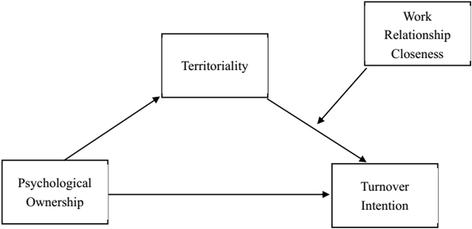
Sample
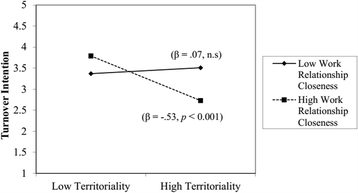
n = 341 (Tong et al., 2017)
Interaction slope
β = -0.53, p < .001
Sample
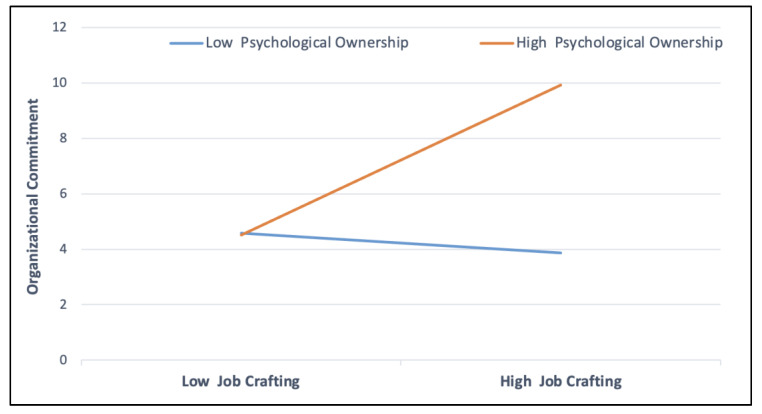
n = 457 (Wang et al., 2025)
Moderation effect
β = 0.17, p < .001
Decision guidance
3 Quick ActionsBibliography
Verification SourcesValidated on February 24, 2026.
Scope note: figures in the Online Figures section are directly sourced from published papers.